

AI Trends 2026: What's Changing Across Data, GenAI and Robotics
The five AI shifts of 2026, from agents and open models to robots and new data rules, with sources, why each matters and what learners should do next.
Think of a cloth merchant in Rajwada who has run the same shop for thirty years. In one decade he moved from a paper ledger to a billing computer, then to UPI, then to taking orders on WhatsApp.
The cloth never changed. The way he served customers changed every few years, and the shopkeepers who adapted early were the ones still busy.
AI in 2026 looks like that shop. The basics (data, statistics, Python, SQL, good judgement) have not moved. What moved is the layer on top: how models are reached, who can afford them, and where they run.
This report maps the biggest shifts, as reported by primary sources up to November 2026, onto the four fields Debugshala teaches. For each one you get the evidence, why it matters, and what to do next.
The five AI trends of 2026 at a glance
An AI trend, in this report, is a change backed by published data or official releases that changes the skills a working professional needs. Hype without a source is left out.
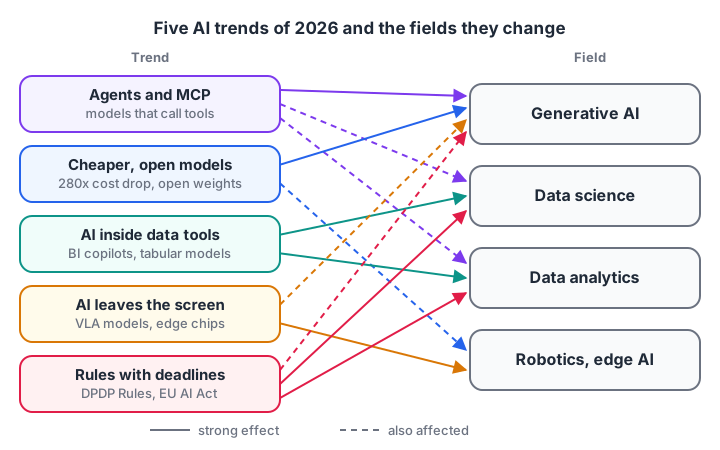
Each 2026 trend touches more than one field; the strongest links are shown as solid lines.
The diagram shows why a narrow view is risky. Agents are not only a GenAI topic: they now sit inside BI tools and notebooks. Foundation models are not only chatbots: they forecast sales and drive robot arms.
Trend 1: AI agents and tool standards move into production
Agents are programs where a language model decides which tool to call next, reads the result and continues. In 2025 this moved from demos to real projects. McKinsey's State of AI 2025 survey found that 23% of respondents' organisations were scaling an agentic AI system somewhere in the enterprise, with another 39% experimenting.
The plumbing also standardised. The Linux Foundation formed the Agentic AI Foundation on 9 December 2025, with Anthropic's Model Context Protocol (MCP), Block's goose and OpenAI's AGENTS.md as founding projects. As of November 2026 the current MCP specification is version 2026-07-28.
Caution is reported too. Gartner predicted in June 2025 that over 40% of agentic AI projects will be cancelled by the end of 2027, citing costs and unclear value.
Why it matters: employers now ask for people who can connect a model to real data and tools safely, not only write prompts.
What to do: build one small agent that calls two tools, add a step limit and log every call. The sister site's guide to how MCP connects models to tools is a good start.
Trend 2: Models got cheaper, and open models stayed close
Stanford's AI Index 2025 reported that the inference cost of a system performing at GPT-3.5 level fell more than 280-fold between November 2022 and October 2024. The same report found open-weight models had narrowed the gap with closed models from 8% to 1.7% on some benchmarks within a year.
The AI Index 2026 adds nuance: as of March 2026 the top closed model led the top open model by 3.3%, so the gap reopened slightly. Open-weight releases kept coming anyway, including OpenAI's gpt-oss models (August 2025) and Google's Gemma 4 under Apache 2.0 (April 2026).
Why it matters: when a capable model can run on one GPU or even a laptop, companies can keep data in-house. That creates work in choosing, hosting and evaluating models.
What to do: learn to compare two models on your own small test set instead of trusting leaderboards. Our generative AI trends report covers evaluation in detail.
Quick check
According to Stanford's AI Index 2025, roughly how much did the cost of GPT-3.5-level inference fall between November 2022 and October 2024?
The AI Index 2025 reported a drop of more than 280 times over that period.
Trend 3: AI assistants sit inside data tools
Data teams felt AI first in their everyday tools. Databricks made its AI/BI Genie natural-language interface generally available in June 2025, saying more than 4,000 customers adopted it during preview. Google made Conversational Analytics in Looker generally available in November 2025. Microsoft opened Copilot in Fabric to all paid capacities from F2 upwards in April 2025.
For data science, tabular foundation models arrived. TabPFN, published in Nature in January 2025, predicts on small tables without training a new model per dataset. Pandas 3.0, released on 21 January 2026, changed defaults such as Copy-on-Write that every analyst will meet.
Why it matters: if anyone can ask a chart question in plain English, the analyst's value moves to clean definitions, correct joins and checking the answer.
What to do: get strong at SQL and at defining metrics precisely. Read the data analytics trends report and the data science and ML trends report.
Trend 4: AI leaves the screen for robots and edge devices
Vision-language-action (VLA) models take a camera image plus an instruction and output robot actions. Google DeepMind released Gemini Robotics 2 on 30 July 2026, and open VLAs such as Hugging Face's 450-million-parameter SmolVLA (June 2025) can be trained on a single consumer GPU.
The factory floor grew too. The International Federation of Robotics (IFR) reported in September 2026 that more than 600,000 industrial robots were installed worldwide in 2025, and that India installed about 10,500, ranking sixth.
Why it matters: robotics now needs people who understand both electronics and models.
What to do: get a microcontroller project working, then add a camera and a small on-device model. Our robotics and edge AI trends report lists the hardware tiers.
Trend 5: Data and AI rules became real deadlines
India notified the Digital Personal Data Protection (DPDP) Rules in November 2025, with most obligations applying from May 2027. MeitY released the India AI Governance Guidelines on 5 November 2025, built on seven principles it calls "sutras". In the EU, obligations for general-purpose AI model providers have applied since 2 August 2025.
Why it matters: every model or dashboard that touches personal data now has a compliance angle, and freshers who understand consent and data minimisation stand out.
What to do: for every project, write down what personal data it uses and why. Treat it as part of the documentation, not an afterthought.
What these AI trends mean for your learning plan
The common thread is that tools are easier to use and harder to trust. That makes fundamentals more valuable: statistics to check a result, SQL to verify a number, and Python to automate the boring parts.
If you want those foundations taught in order with mentors, Debugshala's Generative AI programme covers the path from Python to machine learning. For a view of what Indian employers ask for, see AI and data skills in demand in India.
Key takeaways
- Agents that call tools moved into production in 2025, with shared standards such as MCP, but many projects still fail.
- Inference became far cheaper and open-weight models stayed within a few percentage points of closed ones.
- BI tools and notebooks now ship AI assistants, so clean metrics and verification matter more.
- Robots and edge devices are the next home for foundation models, and India is a top-ten robot market.
- DPDP Rules and AI guidelines make data handling part of every job.
Test your fundamentals with aptitude and coding quizzes on Debugshala Test before you dive into the field reports.
FAQ
What is the biggest AI trend in 2026?
As of November 2026, the most widely reported shift is AI agents: models that call tools and complete multi-step tasks. Surveys from McKinsey and Stanford show many organisations experimenting, but far fewer have scaled agents across a whole function. Learning to build and test agents safely is therefore a practical skill, not only a buzzword.
Will AI assistants replace data analysts?
The evidence so far shows assistants changing the job, not removing it. Natural-language tools still depend on clean data and clear metric definitions, and someone has to check that the answer is right. Analysts who can do that checking are more useful with these tools, not less.
Which field should a beginner pick in 2026?
Pick the one whose daily work you enjoy. Analytics suits people who like business questions and dashboards, data science suits those who like statistics and modelling, generative AI suits builders of applications, and robotics suits people who like hardware. All four share Python, data handling and testing habits.
Can I learn these AI skills in Indore?
Yes. Debugshala teaches Data Science & AI, Data Analytics, Generative AI, Machine Learning and Robotics at its Old Palasia campus in Indore, in English and Hindi, and some courses are also available online. You can attend a free demo class before you pay anything, and fresh graduates and non-IT learners can join.
Sources
- The 2025 AI Index Report, Stanford HAI, April 2025
- AI Index 2026: Technical Performance, Stanford HAI, April 2026
- The state of AI in 2025: Agents, innovation, and transformation, McKinsey, November 2025
- Linux Foundation announces the formation of the Agentic AI Foundation, Linux Foundation, 9 December 2025
- MCP specification versioning, Model Context Protocol, July 2026
- Gartner predicts over 40% of agentic AI projects will be canceled by end of 2027, Gartner, 25 June 2025
- Introducing gpt-oss, OpenAI, 5 August 2025
- Gemma 4, Google, 2 April 2026
- AI/BI Genie is now generally available, Databricks, 12 June 2025
- Copilot and AI capabilities now accessible to all paid SKUs in Microsoft Fabric, Microsoft Fabric Blog, April 2025
- Conversational Analytics in Looker is now GA, Google Cloud, November 2025
- Accurate predictions on small data with a tabular foundation model (TabPFN), Nature, 8 January 2025
- pandas 3.0 released, pandas, 21 January 2026
- Gemini Robotics 2 brings whole-body intelligence to robots, Google DeepMind, 30 July 2026
- SmolVLA, Hugging Face, 3 June 2025
- Five million robots now operate in factories globally, International Federation of Robotics, 24 September 2026
- Digital Personal Data Protection Rules, 2025 (backgrounder), PIB, 17 November 2025
- India AI Governance Guidelines, PIB / MeitY, 5 November 2025
- Guidelines for providers of general-purpose AI models, European Commission, 2025
Quick check
Which body hosts the Model Context Protocol through the Agentic AI Foundation?
The Linux Foundation announced the Agentic AI Foundation on 9 December 2025 with MCP as a founding project.
From the team behind this site
Go further with the Generative AI Course at Debugshala
These tutorials are written by Debugshala, a training and placement institute at Old Palasia, Indore. The classroom course adds live mentoring, real projects and interview preparation.
- Offline classes at Old Palasia, Indore
- Free demo class before you pay
- Non-IT, fresher and year-gap friendly
- Placement assistance
700+ students placed · 200+ hiring partners · 4.9★ Google rating
