

Generative AI Trends 2026: Agents, MCP, Open Models and More
Sourced 2026 generative AI trends: agentic workflows, MCP and A2A, open-weight models, multimodal input, guardrails and the falling cost of inference.
Picture a busy wedding caterer in Indore. A few years ago one head cook did everything from memory. Now the head cook reads the order, sends the tandoor team one job, the sweets counter another, checks the stock register, and tastes every dish before it leaves.
The head cook is still essential, but the kitchen works because of the hand-offs and the tasting. Generative AI went through the same change between 2025 and 2026.
The language model is the head cook. Tools, protocols and evaluations are the kitchen around it. This report covers what actually shipped and was reported, and what you should learn because of it.
From chatbots to agentic workflows
An agentic workflow is a system where a language model plans steps, calls tools or other agents, reads the results, and repeats until a goal is met.
The reported adoption is real but uneven. In McKinsey's State of AI 2025 survey, 23% of respondents said their organisation was scaling an agentic AI system somewhere, 39% were experimenting, and no more than 10% were scaling agents in any single business function.
Stanford's AI Index 2026 reports that agent deployment remains in the single digits across nearly all business functions.
Capability rose fast. The AI Index 2026 shows agent accuracy on the OSWorld computer-use benchmark climbing from about 12% to 66.3%, against a human baseline of 72.35%. Agents still fail roughly one task in three.
Vendors packaged the tooling. OpenAI launched AgentKit, including Agent Builder and evaluation tools, at DevDay on 6 October 2025.
Gartner adds a warning: in June 2025 it predicted that over 40% of agentic AI projects will be cancelled by the end of 2027, and estimated that only about 130 of the thousands of vendors claiming "agentic" products are genuine.
Why it matters: the skill employers want is building a loop that works reliably, not a demo that works once.
What to do: read how an AI agent's loop works, then build one with a step limit, logging and a test set of 20 tasks.
MCP and tool standards became shared infrastructure
Before standards, every app wired every tool by hand. The Model Context Protocol (MCP) defines one way for an AI application to discover and call tools, read resources and use prompts from a server.
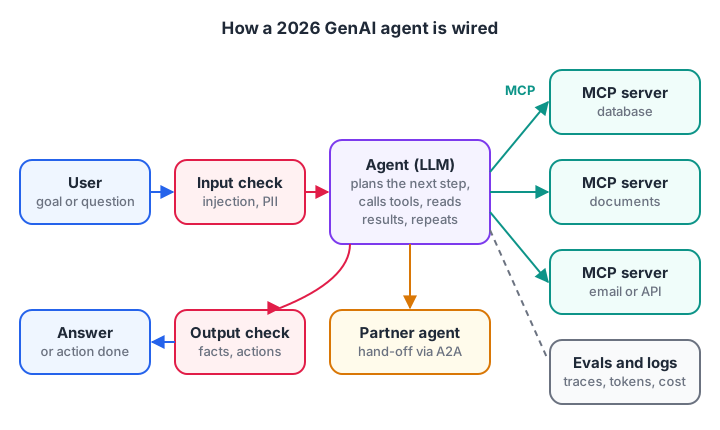
An agent reaches tools through MCP servers and other agents through A2A, with guardrails checking inputs, outputs and actions.
Three reported milestones:
- On 9 December 2025 the Linux Foundation formed the Agentic AI Foundation, with MCP (from Anthropic), goose (from Block) and AGENTS.md (from OpenAI) as founding projects. Platinum members included AWS, Google, Microsoft and OpenAI, and the announcement cited more than 10,000 published MCP servers.
- As of November 2026 the current MCP specification is 2026-07-28. It moved to a stateless core, retiring the old initialise handshake and session header. The MCP project said its main SDKs see close to half a billion downloads a month.
- Google's Agent2Agent (A2A) protocol, for agents talking to other agents, moved to a Linux Foundation project on 23 June 2025 with founding members including AWS, Cisco, Microsoft, Salesforce, SAP and ServiceNow.
Why it matters: because the spec changed in 2026, tutorials written in 2025 may show the older handshake. Read the official changelog, not only blog posts.
What to do: write one small MCP server that exposes two tools from a CSV or database, and connect it to a client.
Quick check
As of November 2026, which MCP specification version is current?
The MCP project lists 2026-07-28 as the current version; the previous one was 2025-11-25.
Open-weight and small models stayed competitive
An open-weight model is one whose trained weights you can download and run yourself, usually under a licence that allows commercial use.
The gap with closed models shrank and then reopened a little. Stanford's AI Index 2025 found open-weight models narrowed their gap from 8% to 1.7% on some benchmarks in one year. The AI Index 2026 reports that, as of March 2026, the top closed model led the top open model by 3.3%.
Notable releases, as reported by their publishers:
| Date | Release | Detail |
|---|---|---|
| Aug 2025 | OpenAI gpt-oss-120b and gpt-oss-20b | Apache 2.0; the smaller model fits in about 16 GB |
| Feb 2026 | Alibaba Qwen3.5-397B-A17B | Apache 2.0, native text, image and video input |
| Apr 2026 | Google Gemma 4 | Moved to Apache 2.0; sizes from E2B to 31B |
Small, open models matter in India for a practical reason: data can stay on your own servers, which helps with the DPDP Rules covered below.
What to do: run a small open model locally, then compare it against a hosted model on the same 30 questions from your domain.
Multimodal is now the default
New flagship and open models accept more than text. Google's Gemini 3 Pro, launched on 18 November 2025, takes text, image, video, audio and code as input. The Qwen3.5 open release above is natively multimodal too.
Why it matters: many Indian business documents are scanned forms, photos and voice notes in several languages. Multimodal input turns those into data without a separate OCR or speech pipeline for every case.
What to do: build one project that reads an image or PDF and answers questions about it, and measure where it fails, for example on handwriting or Hindi text.
Evaluation and guardrails decide what ships
When agents can take actions, mistakes cost more. The OWASP Top 10 for LLM Applications 2025 lists the main risks, starting with prompt injection, sensitive information disclosure and supply chain risks, and includes "excessive agency" (an agent allowed to do too much) and "unbounded consumption" (runaway cost).
Stanford's AI Index 2026 counts documented AI incidents rising from 233 in 2024 to 362 in 2025.
Regulation adds deadlines. In the EU, obligations for general-purpose AI model providers have applied since 2 August 2025, and the Commission's enforcement powers start on 2 August 2026. In India, MeitY's AI Governance Guidelines of 5 November 2025 are voluntary principles, not a new law, organised around seven "sutras" such as Trust, People First and Accountability.
What to do: for every GenAI project, keep a small test set, score answers automatically where you can, and add a human check for anything that sends money, email or data outside. If your project uses document search, the sister site's guide to retrieval-augmented generation shows where grounding helps.
Quick check
Which OWASP 2025 risk describes an LLM agent that has been given more permissions than it needs?
Excessive agency (LLM06) covers agents with too much functionality, permission or autonomy.
The falling cost of inference
Cost decides whether a feature can serve thousands of users. Stanford's AI Index 2025 found that the cost of running a system at GPT-3.5 level fell more than 280-fold between November 2022 and October 2024, with hardware costs falling about 30% a year and energy efficiency improving about 40% a year.
Why it matters: cheaper tokens make longer prompts, agents and multimodal input affordable, but agents also multiply calls, which is why OWASP lists unbounded consumption as a risk.
What to do: log tokens and latency per request from day one, and set a hard budget per task.
To learn these pieces in sequence with mentors, Debugshala's GenAI classroom programme in Indore covers LLMs, RAG and agent building. For the wider picture across fields, see the AI trends 2026 overview, and for the roles hiring for these skills, read which AI skills Indian employers want.
Key takeaways
- Agents are being tried widely but scaled rarely; reliability is the skill gap.
- MCP and A2A now sit under the Linux Foundation, and the MCP spec changed in 2026.
- Open-weight models are within a few points of closed ones and can keep data in-house.
- Multimodal input is standard, which suits India's mix of scanned and spoken data.
- Test sets, guardrails and cost logs are part of the job, not extras.
Sharpen your Python and logic before building agents with quick coding quizzes on Debugshala Test.
FAQ
What are the top generative AI trends in 2026?
As of November 2026, the most reported trends are agentic workflows, shared tool standards such as MCP, competitive open-weight models, native multimodal input, stronger evaluation and guardrails, and much cheaper inference. Each is backed by releases or reports cited below. The skills that tie them together are Python, API use and testing.
Is prompt engineering still worth learning?
Yes, as one part of a larger skill set. Prompts are still how you instruct a model, but most production work now involves tools, retrieval, evaluation and cost control around the prompt. Learn prompting together with those, not instead of them.
Do I need a GPU to work with open-weight models?
Not to start. Small open models run on a laptop CPU for experiments, and hosted APIs let you test larger ones. A GPU becomes important when you fine-tune models or serve many users, and the gpt-oss-20b model, for example, is described as fitting in about 16 GB of memory.
Where can I learn generative AI hands-on in Indore?
Debugshala teaches a Generative AI course at its Old Palasia campus in Indore, in English and Hindi. Fresh graduates, non-IT learners and people with a year gap can join, and there is a free demo class before you pay anything. Admissions can be reached on +91-8982385539.
Sources
- The state of AI in 2025: Agents, innovation, and transformation, McKinsey, November 2025
- AI Index 2026: Technical Performance, Stanford HAI, April 2026
- AI Index 2026: Economy, Stanford HAI, April 2026
- The 2026 AI Index Report, Stanford HAI, April 2026
- The 2025 AI Index Report, Stanford HAI, April 2025
- OpenAI launches AgentKit to help developers build and ship AI agents, TechCrunch, 6 October 2025
- Gartner predicts over 40% of agentic AI projects will be canceled by end of 2027, Gartner, 25 June 2025
- Linux Foundation announces the formation of the Agentic AI Foundation, Linux Foundation, 9 December 2025
- MCP specification 2026-07-28 release, Model Context Protocol blog, 28 July 2026
- Linux Foundation launches the Agent2Agent protocol project, Linux Foundation, 23 June 2025
- Introducing gpt-oss, OpenAI, 5 August 2025
- Qwen3.5 repository, Alibaba Qwen on GitHub, 16 February 2026
- Gemma 4, Google, 2 April 2026
- A new era of intelligence with Gemini 3, Google, 18 November 2025
- OWASP Top 10 for LLM Applications 2025, OWASP GenAI Security Project, 2025
- Guidelines for providers of general-purpose AI models, European Commission, 2025
- MeitY unveils India AI Governance Guidelines, PIB, 5 November 2025
From the team behind this site
Go further with the Generative AI Course at Debugshala
These tutorials are written by Debugshala, a training and placement institute at Old Palasia, Indore. The classroom course adds live mentoring, real projects and interview preparation.
- Offline classes at Old Palasia, Indore
- Free demo class before you pay
- Non-IT, fresher and year-gap friendly
- Placement assistance
700+ students placed · 200+ hiring partners · 4.9★ Google rating
