

Robotics and Edge AI Trends 2026: Humanoids, VLAs and ROS 2
Robotics trends 2026: record robot installs and India's rank, humanoid pilots, vision-language-action models, edge AI boards and ROS 2, all sourced.
Imagine a tea stall near Indore's Palasia square that hires a helper who can only follow fixed steps: boil water, add leaves, pour. Change the cup size and he is lost. Now imagine a helper you can simply tell, "Make two cutting chai, less sugar," who looks at the counter and works it out.
The first helper is a classic industrial robot: precise and fast, but programmed for one job. The second is what robotics researchers are now chasing with general-purpose robots and vision-language-action models.
Both kinds matter in 2026. Fixed robots are filling factories in record numbers, while the flexible kind is in early, named pilots. This report covers what was actually reported, and what a learner should build because of it.
Industrial robots hit a record, and India climbs
The International Federation of Robotics (IFR) publishes the standard annual count. Its World Robotics 2026 release on 24 September 2026 reported:
- More than 600,000 industrial robots installed worldwide in 2025, up 11%, with the global operating stock reaching a record 5 million.
- China installed 354,000 units, 59% of the world total.
- India installed about 10,500 robots in 2025, up 15%, ranking sixth in the world, with average annual growth of 27% from 2020 to 2025.
- The IFR forecasts 655,000 installations worldwide in 2026.
In the previous year's report, the IFR said India's automotive industry was the largest customer, with a 45% share of 2024 installations.
Why it matters: these are mostly robot arms in car, electronics and metal plants, and each needs people to install, program, maintain and integrate them with sensors and software.
What to do: learn the basics that every robot cell uses: sensors, motor control, safety interlocks and simple programming logic.
Quick check
According to the IFR's World Robotics 2026, where did India rank for new industrial robot installations in 2025?
India installed about 10,500 robots in 2025 and ranked sixth worldwide.
Humanoid and general-purpose robots: real pilots, small numbers
Humanoids got serious attention in 2026, but the reported deployments are specific and limited:
| Company | What was reported | When |
|---|---|---|
| Boston Dynamics | Production electric Atlas shown at CES 2026; 2026 output committed to Hyundai and Google DeepMind | January 2026 |
| Figure and BMW | Figure 02 supported production of more than 30,000 BMW X3s at Spartanburg; Figure 03 to sort parts there next | June 2026 |
| Agility Robotics | Digit has moved more than 100,000 totes at a GXO warehouse in Georgia; expansion planned from early 2027 | October 2026 |
| Tesla | Q3 2026 letter says it is building the first production-quality Optimus robots on a Fremont line | October 2026 |
| Unitree | Listed on Shanghai's STAR Market on 19 August 2026; research firm Omdia counted about 15,000 humanoids shipped worldwide in 2025 | August 2026 |
Compare those 15,000 humanoids with 600,000 industrial robots in the same year. As of November 2026, humanoids are a fast-growing niche, not yet the factory norm.
Why it matters: the skills behind humanoids (perception, control, safety, integration) are the same skills behind every mobile robot and arm.
Vision-language-action models give robots a "brain"
A vision-language-action (VLA) model takes camera images and a natural-language instruction as input and outputs robot actions, such as joint movements or gripper commands.
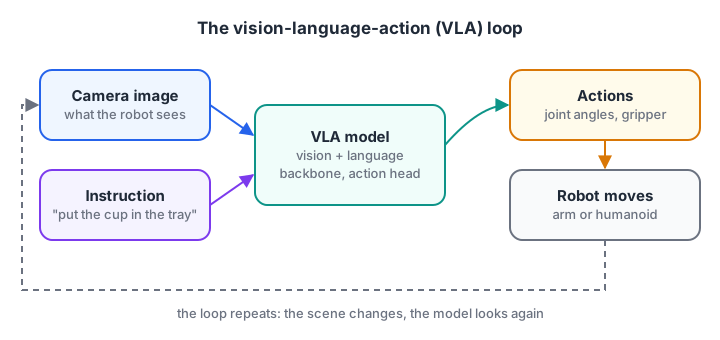
A VLA model closes the loop: it sees the scene, reads the instruction, outputs actions, then sees the result.
Reported releases:
- Google DeepMind released Gemini Robotics On-Device, a VLA that runs locally on a robot, on 24 June 2025, and Gemini Robotics 2 on 30 July 2026, which it says can control full humanoids. Its embodied-reasoning model, Gemini Robotics-ER 2, is available in Google AI Studio.
- NVIDIA announced Isaac GR00T N1.6, an open reasoning VLA for humanoids, on 29 September 2025, alongside the open-source Newton physics engine.
- Physical Intelligence publishes π0 and π0.5 as open weights in its openpi repository. Its README says inference needs a GPU with more than 8 GB of memory.
- Hugging Face released SmolVLA, a 450-million-parameter open VLA trained on community LeRobot datasets, on 3 June 2025. It can be trained on a single consumer GPU and tested on low-cost SO-100 and SO-101 arms.
Why it matters: students can now experiment with the same class of model used in research labs, on hardware that costs far less than an industrial arm.
What to do: first get a simple arm or car moving reliably with classic code. Then collect a few dozen demonstrations and try fine-tuning a small open VLA.
Quick check
What does a vision-language-action model output?
VLAs take images and instructions as input and produce actions for the robot.
On-device AI and NPUs: the edge got powerful
Edge AI means running a model on the device itself (a robot, camera or board) instead of sending data to the cloud. It cuts delay, works offline and keeps data local. The sister site explains why edge AI matters for robots in more depth.
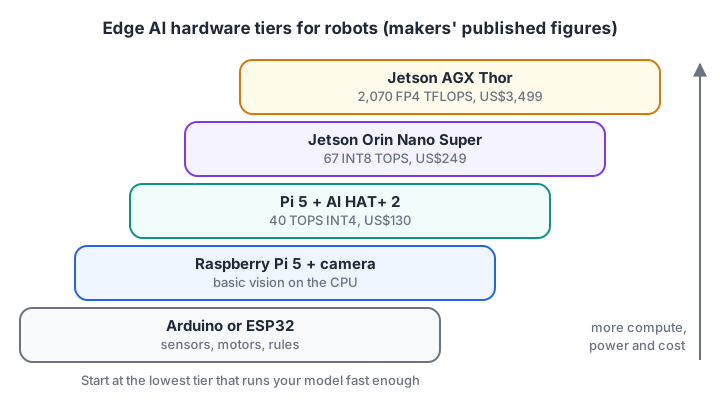
Pick the smallest tier that runs your model fast enough; prices and figures are as published by each maker.
Reported hardware:
- Raspberry Pi AI HAT+ 2, launched on 15 January 2026 at US$130, adds a Hailo-10H accelerator rated at 40 TOPS (INT4) with 8 GB of its own memory. Raspberry Pi calls it its first board for running language and vision-language models on a Pi 5.
- NVIDIA Jetson Orin Nano Super developer kit, announced on 17 December 2024 at US$249, delivers 67 INT8 TOPS.
- NVIDIA Jetson AGX Thor developer kit, on sale from 25 August 2025 at US$3,499, offers up to 2,070 FP4 TFLOPS and 128 GB of memory for humanoid-class robots.
- On laptops, Microsoft requires an NPU of more than 40 TOPS for a Copilot+ PC.
What to do: run a small object-detection model on a Raspberry Pi with a camera, measure frames per second, then try it with an accelerator. That one experiment teaches you most edge AI trade-offs.
ROS 2 is the default robot software stack
The Robot Operating System (ROS) is the open middleware most robots use to pass messages between sensors, planners and motors.
- ROS 1 Noetic reached end of life on 31 May 2025, so new projects should use ROS 2.
- ROS 2 Lyrical Luth, released on 22 May 2026, is a long-term support release supported until May 2031, on Ubuntu 26.04. Jazzy Jalisco (May 2024) is supported until May 2029, while Kilted Kaiju support ends in November 2026.
- Open Robotics' 2025 ROS Metrics report counted 984 million package downloads, up 85%, with ROS 2 making up 91.2% of them.
What to do: learn nodes, topics and launch files on Jazzy or Lyrical. The sister site's ROS 2 basics tutorial walks through your first publisher and subscriber.
Quick check
Which ROS version reached end of life on 31 May 2025?
Noetic was the last ROS 1 release; Jazzy and Lyrical are supported ROS 2 LTS releases.
Robotics policy and industry in India
India's robot market is growing from a manufacturing base led by automobiles, as the IFR data above shows. On policy, MeitY published a draft National Strategy on Robotics for public comment in 2023, aiming to make India a robotics leader by 2030.
In February 2026, Dataquest India reported that the Principal Scientific Adviser's Technology Advisory Group had set out a roadmap focused on "embodied intelligence", proposing to align the robotics strategy with the IndiaAI and Semiconductor Missions. As of November 2026, we found no officially launched national robotics mission with a budget, so treat those as proposals.
If you want to build these skills hands-on, from Arduino and ESP32 to Raspberry Pi vision and ROS 2 basics, the project-based robotics course at Debugshala in Indore follows that path. For how robotics fits the wider AI picture, read the AI trends 2026 overview and AI and data skills in demand in India.
Key takeaways
- Industrial robot installs hit records in 2025, and India is now sixth in the world.
- Humanoids are in real but small pilots; treat volume targets as targets, not facts.
- Open VLA models such as SmolVLA and π0 let students experiment with robot learning.
- Edge accelerators from Raspberry Pi and NVIDIA make on-device vision and language models practical.
- ROS 2 is the standard; learn it on an LTS release.
Warm up your logic and Python before your next robot build with coding challenges on Debugshala Test.
FAQ
What are the biggest robotics trends in 2026?
As of November 2026, the main reported trends are record industrial robot installations, early humanoid deployments in factories and warehouses, vision-language-action models, cheaper and stronger edge AI hardware, and ROS 2 becoming the standard software stack. All are sourced below.
Is robotics a good career in India?
The IFR reports India's robot installations growing for several years, led by the automotive industry, which creates demand for people who can integrate, program and maintain robots. Robotics combines electronics, programming and AI, so it suits learners who enjoy building physical things and debugging both hardware and code.
Do I need expensive hardware to learn robotics and edge AI?
No. You can start with an Arduino or ESP32, a few sensors and motors, and later a Raspberry Pi with a camera. Open models such as SmolVLA were designed to be trained on a single consumer GPU and tested on low-cost arms.
Where can I learn robotics in Indore?
Debugshala runs a project-based Robotics course at its Old Palasia campus. It covers Python for robotics, electronics and safe wiring, Arduino and ESP32, sensors and motors, line-follower and obstacle-avoiding robots, Raspberry Pi with a camera for basic computer vision, ROS 2 basics and a final project. You can attend a free demo class first.
Sources
- Five million robots now operate in factories globally, International Federation of Robotics, 24 September 2026
- India press release, World Robotics 2025, International Federation of Robotics, 25 September 2025
- Boston Dynamics puts Atlas into production, The Register, 6 January 2026
- BMW Group advances the use of physical AI in production with Figure 03, BMW Group, 25 June 2026
- Agility and GXO plan expanded deployment of Digit, The Robot Report, 26 October 2026
- Tesla starts Optimus robot production in California, TechCrunch, 21 October 2026
- Shares in Unitree soar in Shanghai trading debut, BNN Bloomberg, 19 August 2026
- Gemini Robotics On-Device brings AI to local robotic devices, Google DeepMind, 24 June 2025
- Gemini Robotics 2 brings whole-body intelligence to robots, Google DeepMind, 30 July 2026
- NVIDIA accelerates robotics research with new open models and simulation libraries, NVIDIA, 29 September 2025
- openpi repository, Physical Intelligence on GitHub, September 2025
- SmolVLA: efficient vision-language-action model, Hugging Face, 3 June 2025
- Introducing the Raspberry Pi AI HAT+ 2, Raspberry Pi, 15 January 2026
- Jetson Orin Nano Super developer kit, NVIDIA, 17 December 2024
- NVIDIA Jetson Thor now available, NVIDIA, 25 August 2025
- Copilot+ PCs and NPU devices, Microsoft Learn, August 2026
- ROS Noetic end of life, 31 May 2025, Open Robotics Discourse, 2025
- ROS 2 Lyrical Luth released, Open Robotics Discourse, 22 May 2026
- ROS 2 Jazzy Jalisco released, Open Robotics, May 2024
- ROS 2 Kilted Kaiju released, Open Robotics, 23 May 2025
- 2025 ROS Metrics Report, Open Robotics Discourse, 19 February 2026
- Draft National Strategy on Robotics, MyGov / MeitY, 2023
- India outlines strategic roadmap for self-reliant robotics and physical AI, Dataquest India, 4 February 2026
From the team behind this site
Go further with the Generative AI Course at Debugshala
These tutorials are written by Debugshala, a training and placement institute at Old Palasia, Indore. The classroom course adds live mentoring, real projects and interview preparation.
- Offline classes at Old Palasia, Indore
- Free demo class before you pay
- Non-IT, fresher and year-gap friendly
- Placement assistance
700+ students placed · 200+ hiring partners · 4.9★ Google rating
