

Data Science and ML Trends 2026: AutoML, MLOps and Regulation
Data science trends for 2026: AutoML agents, tabular foundation models, MLflow 3, pandas 3.0, and India's DPDP Rules, with sources and learner advice.
Imagine a sweet shop in Sarafa that has always made jalebi batter by hand, tasting and adjusting every batch. Then it buys a machine that mixes a good batter in minutes. The halwai does not disappear. He now decides the recipe, checks every tray, and notices when the flour from a new supplier behaves differently.
That is roughly what happened to data science between 2025 and 2026. Machines got good at the routine mixing: choosing models, tuning settings, even forecasting without training. The data scientist's job moved towards choosing the problem, checking the data and judging the result.
This report walks through the trends that were actually reported, and what you should practise because of each.
AutoML and data science agents in notebooks
AutoML means software that automatically tries many models and settings on your data and returns the best one it finds. In 2025 it gained a conversational layer: agents that write and run notebook code for you.
Reported examples:
- Google added a Data Science Agent to Colab on 3 March 2025. It is powered by Gemini and generates full notebooks from a plain-English request.
- Databricks introduced a Data Science Agent for its Assistant on 3 September 2025, letting it plan and run multi-step analysis in notebooks.
- The open-source AutoGluon library kept raising the bar. Its 1.5 release notes report a new state of the art on the TabArena benchmark and add pretrained tabular and forecasting models to its presets.
Why it matters: if a tool can produce a reasonable baseline in minutes, a junior data scientist is judged on whether they can spot leakage, wrong metrics or a biased sample in that baseline.
What to do: for your next project, run an AutoML baseline first, then try to beat it by improving the data, not only the model. Explain the gap in your write-up.
Foundation models for tabular and time-series data
For years, foundation models meant text and images. In 2025–2026 they arrived for the spreadsheets that most companies actually run on.
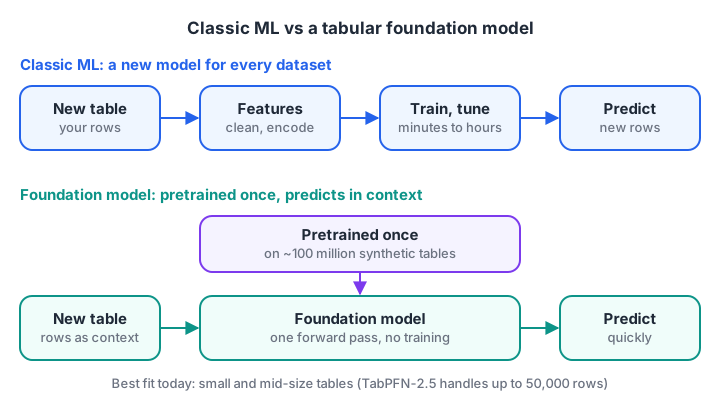
Classic ML trains a new model per dataset; a tabular or time-series foundation model is pretrained once and predicts from examples in context.
A tabular foundation model is a neural network pretrained on many datasets so it can predict on a new table without being trained on it from scratch.
| Model | Publisher | What was reported |
|---|---|---|
| TabPFN | Prior Labs | Published in Nature in January 2025; trained on about 100 million synthetic datasets; strong on tables up to 10,000 rows |
| TabPFN-2.5 | Prior Labs | November 2025 paper: up to 50,000 rows and 2,000 features |
| Chronos-2 | Amazon | October 2025: univariate, multivariate and covariate forecasting; Chronos models downloaded over 600 million times from Hugging Face |
| TimesFM 2.5 | Google Research | September 2025: about 200M parameters with 16k context |
TabPFN is also a striking data-centric result: a model trained only on synthetic tables beats tuned baselines on many real ones. Licences differ, so check before using any of these commercially; for example, Google's TimesFM README says its newest weights are under a non-commercial licence, with commercial use through Google Cloud.
Why it matters: for small datasets, which is most business data in Indian SMEs, a pretrained model can be a strong first baseline in seconds.
What to do: compare a gradient-boosted tree, AutoML and a tabular foundation model on the same split, using the right metric. The sister site's guide to choosing model evaluation metrics helps you avoid the classic accuracy trap.
Quick check
What makes TabPFN different from a classic gradient-boosted model?
TabPFN is pretrained on synthetic datasets and predicts on small new tables in context.
MLOps grows into LLMOps
MLOps is the practice of tracking, deploying and monitoring models; LLMOps extends it to language-model apps, where you trace prompts, tool calls and answers.
MLflow 3, launched on 9 June 2025, put GenAI tracing at its centre, with more than 20 tracing integrations, one-line autologging for common LLM libraries, and an evaluation framework with custom scorers. AWS made fully managed MLflow 3.0 available on SageMaker AI in July 2025.
LangChain's State of Agent Engineering survey, a vendor-run survey of 1,340 people from late 2025, found 89% had some observability on their agents but only 52.4% ran offline evaluations. Treat it as one indicator, not a census.
Why it matters: the gap between "we log things" and "we measure quality" is where data scientists add value.
What to do: add experiment tracking to every project, even a student one. Log the dataset version, parameters and metric for every run.
The Python data stack changed under your feet
Two changes affect anyone who learned from older tutorials:
- pandas 3.0 was released on 21 January 2026. Strings now use a dedicated string dtype by default, and Copy-on-Write is the default, so chained assignment such as
df[df.a > 0]["b"] = 1no longer modifiesdf. Usedf.loc[df.a > 0, "b"] = 1. - Python 3.14, released on 7 October 2025, officially supports the free-threaded (no-GIL) build as an option under PEP 779. scikit-learn 1.8 shipped free-threaded wheels for it.
Python's lead keeps growing: in the Stack Overflow Developer Survey 2025, 57.9% of respondents used Python, about 7 points more than in 2024. The same survey found 84% use or plan to use AI tools, but more respondents distrusted AI accuracy (46%) than trusted it (33%).
What to do: upgrade one old notebook to pandas 3.0 and fix every warning. It is the fastest way to learn the new defaults. If you are new to Python, start with your first Python program.
Quick check
In pandas 3.0, what happens to the chained assignment df[df.a > 0]["b"] = 1?
Copy-on-Write makes the intermediate selection a copy, so use df.loc[mask, "b"] = 1 instead.
Responsible AI and regulation, with India's context
Rules on data and AI now have dates attached.
India. The Digital Personal Data Protection Rules, 2025 were notified in November 2025 with an 18-month phased rollout: Data Protection Board provisions immediately, consent-manager rules about 12 months later (November 2026), and most obligations, including consent notices, security safeguards and breach reporting, from May 2027.
MeitY's India AI Governance Guidelines of 5 November 2025 are voluntary principles built on seven "sutras", not a new law.
The IndiaAI Mission, approved in March 2024 with an outlay of ₹10,371.92 crore, reported in a December 2025 PIB backgrounder that 38,000 GPUs were onboarded at a subsidised rate of ₹65 per hour, and that its AIKosh platform hosts more than 5,500 datasets.
European Union. The AI Act was amended by a "Digital Omnibus" approved by the European Parliament in June 2026. It moves obligations for standalone high-risk AI systems from 2 August 2026 to 2 December 2027, and for AI embedded in regulated products to 2 August 2028.
Why it matters: Indian teams building models for EU clients, or on Indian personal data, now need documentation of data sources, consent and model behaviour.
What to do: add a one-page "model card" to every project: data source, consent basis, known biases and evaluation results.
If you want a guided route from Python and statistics to these modern tools, the Data Science & AI course at Debugshala is built for that.
Those who want to focus on algorithms and model building can look at Debugshala's machine learning training in Indore. For the broader picture, read the AI trends 2026 overview and the skills employers in India ask for.
Quick check
When do most obligations under India's DPDP Rules, 2025 apply?
The Rules phase in over 18 months; consent, security and breach-reporting duties start around May 2027.
Key takeaways
- AutoML and notebook agents make baselines cheap, so judgement and data quality become the differentiators.
- Pretrained models for tables and time series are real options for small business datasets; check licences.
- MLflow 3 and similar tools made tracing and evaluation standard parts of MLOps.
- pandas 3.0 and free-threaded Python change defaults that older tutorials rely on.
- DPDP Rules and the revised EU AI Act timeline make documentation a core skill.
Brush up your statistics and Python basics with timed MCQ practice on Debugshala Test.
FAQ
What are the main data science trends in 2026?
As of November 2026, the main reported trends are AutoML and data science agents in notebooks, pretrained foundation models for tabular and time-series data, MLOps expanding into LLMOps, changes in the Python stack such as pandas 3.0, and new data and AI rules in India and the EU. Each is sourced at the end of this article.
Will AutoML replace data scientists?
The tools automate model selection and tuning, which used to take a lot of time. They do not decide which problem matters, whether the data is biased, or which metric reflects the business goal. Those decisions are where data scientists now spend more of their time.
Do I still need to learn classic machine learning?
Yes. You cannot judge an AutoML result or a foundation model's prediction without understanding train-test splits, overfitting and evaluation metrics. Classic models such as decision trees and logistic regression are also still common baselines in industry.
Where can I learn data science and machine learning in Indore?
Debugshala teaches Data Science & AI and Machine Learning courses at its Old Palasia campus, with Data Science & AI also available online. Classes are in English and Hindi, and fresh graduates and non-IT learners can join. You can attend a free demo class first.
Sources
- Data Science Agent in Colab with Gemini, Google Developers Blog, 3 March 2025
- Introducing the Databricks Assistant Data Science Agent, Databricks, 3 September 2025
- AutoGluon 1.5.0 release notes, AutoGluon, 2025
- Accurate predictions on small data with a tabular foundation model (TabPFN), Nature, 8 January 2025
- TabPFN-2.5 technical report, Prior Labs on arXiv, 6 November 2025
- Introducing Chronos-2, Amazon Science, 20 October 2025
- TimesFM repository and changelog, Google Research on GitHub, 2026
- MLflow 3 launch, MLflow, 9 June 2025
- Fully managed MLflow 3.0 on Amazon SageMaker AI, AWS, July 2025
- State of Agent Engineering, LangChain, December 2025
- What's new in pandas 3.0.0, pandas, 21 January 2026
- PEP 779: Criteria for supported status for free-threaded Python, Python Software Foundation, 2025
- scikit-learn 1.8 release highlights, scikit-learn, December 2025
- Stack Overflow Developer Survey 2025: Technology, Stack Overflow, July 2025
- Stack Overflow Developer Survey 2025: AI, Stack Overflow, July 2025
- Digital Personal Data Protection Rules, 2025 (backgrounder), PIB, 17 November 2025
- MeitY unveils India AI Governance Guidelines, PIB, 5 November 2025
- IndiaAI Mission backgrounder, PIB, 30 December 2025
- AI Act: EP approves simplification measures and nudifier app ban, European Parliament, 16 June 2026
From the team behind this site
Go further with the Generative AI Course at Debugshala
These tutorials are written by Debugshala, a training and placement institute at Old Palasia, Indore. The classroom course adds live mentoring, real projects and interview preparation.
- Offline classes at Old Palasia, Indore
- Free demo class before you pay
- Non-IT, fresher and year-gap friendly
- Placement assistance
700+ students placed · 200+ hiring partners · 4.9★ Google rating
