

Agentic AI Glossary: 40 Must-Know Terms Explained Simply
Agentic AI glossary: 40 must-know terms, from agent loop and tool calling to MCP, A2A, guardrails and agentic RAG, each in plain English with examples.
On your first day in the support team of an IT company at Indore's Crystal IT Park, your team lead says, "Check the SLA, escalate to L2 if it's a P1, and update the ticket before handover." Every word is English, yet you understand almost nothing.
Within a week the words are second nature, because someone explained each one once, with an example.
Agentic AI is similar. Framework docs use "tool calling", "handoff" and "A2A" as if everyone knows them.
What is agentic AI?
Agent vocabulary works the same way: a few dozen terms make the field readable. This page is that one-time explanation.
Agentic AI is the design of AI systems in which a language model plans and takes actions toward a goal, using tools, memory and a control loop, with limits set by humans.
The terms below are grouped by where they sit in a running agent. If you have not yet read the introduction to AI agents, skim it first; the glossary will then fill in the gaps.
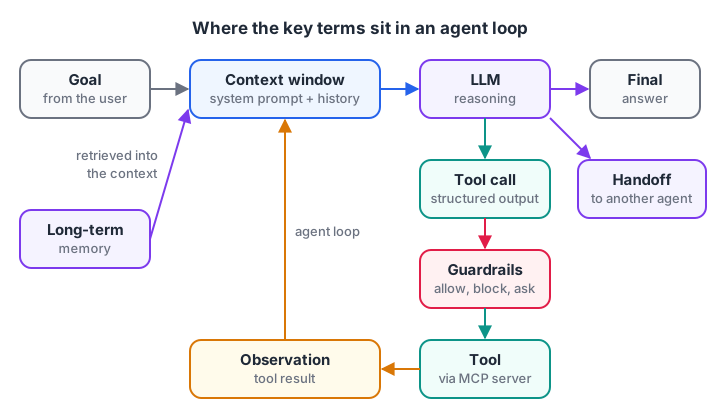
Most glossary terms name one box or one arrow in this loop.
Core agent terms
- Agent: a program in which an LLM repeatedly chooses the next action, such as calling a tool or answering, based on a goal and what it has observed so far.
- Goal: the outcome the agent must achieve, such as "book the cheapest Indore to Delhi train for Friday".
- Environment: everything the agent can observe or change through its tools: databases, files, APIs, websites or other agents.
- Action: one thing the agent does in a step, usually a tool call or a final answer.
- Observation: the result fed back to the agent after an action, such as a search result or an error message.
- Agent loop: the cycle of decide, act, observe, repeated until the goal is met or a limit is hit. It is ordinary code around the model.
- Autonomy: how much the agent decides without human input. It ranges from choosing one branch to setting its own tasks, as described in the five levels of agentic AI.
- Workflow: a fixed sequence of steps written by a developer, possibly with LLM calls inside. Unlike an agent, its path does not change based on the model's choices.
Model and context terms
- LLM (large language model): the neural network that reads text and predicts the next tokens. In an agent it is the decision maker.
- System prompt: standing instructions sent with every call that set the agent's role, rules and output format.
- Context window: the maximum amount of text, measured in tokens, the model can read in one call. Everything the agent knows in a step must fit here.
- Token: a chunk of text, often part of a word, that models read and bill by.
- Context engineering: deciding what goes into the context window on each step: instructions, history, retrieved documents, tool results.
- Few-shot examples: sample inputs and outputs placed in the prompt to show the model the expected behaviour.
- Structured output: model output forced into a fixed format such as JSON, so code can parse it reliably.
- Reasoning (chain of thought): the model working through intermediate steps before deciding. Some models do this internally; others are prompted to write their reasoning out.
Tools, protocols and orchestration terms
- Tool: a function the agent can request, described by a name, a description and parameters. Your code runs it, not the model.
- Tool calling (function calling): the model returning a structured request, a tool name plus arguments, instead of plain text. See tools and function calling.
- Tool schema: the JSON Schema that defines a tool's parameters, types and required fields.
- MCP (Model Context Protocol): an open standard that lets an agent discover and call tools from external servers through one common interface. Start with what MCP is.
- A2A (Agent2Agent protocol): an open protocol for agents built by different teams or vendors to discover each other and exchange tasks.
- AG-UI (Agent-User Interaction protocol): an open protocol for streaming an agent's progress, tool activity and state to a user interface. Both protocols are explained in agent protocols: A2A and AG-UI.
- ReAct: a pattern where the model alternates a thought, an action and an observation.
- Planning: having the model write the steps of a task before executing them, often with dependencies between steps.
- Reflection: the model, or a separate critic, reviewing an output against criteria and revising it.
- Router: a component, often an LLM classification, that sends a request to one of several predefined paths or agents.
- Orchestration: the logic that decides which agent or step runs next and passes information between them.
- Multi-agent system: several agents with distinct roles that cooperate on a task. Patterns are compared in multi-agent system patterns.
- Handoff: one agent transferring control of the conversation to another agent that is better suited.
- Hierarchical agents: a structure where a supervisor agent splits work, delegates to worker agents and combines their results.
Memory, safety and operations terms
- Short-term memory: the current conversation and steps held in the context window. It disappears when the session ends.
- Long-term memory: information stored outside the model and retrieved across sessions, split into semantic (facts), episodic (events) and procedural (how-to). See memory in AI agents.
- Knowledge base: a collection of documents, such as manuals or policies, that an agent can search.
- RAG (retrieval-augmented generation): retrieving relevant passages and adding them to the prompt before the model answers.
- Agentic RAG: RAG where the agent decides when and where to search, can rewrite queries and can check whether results are good enough. See agentic RAG.
- Guardrails: checks around the agent that block or modify unsafe inputs, actions or outputs, such as step limits and tool allowlists.
- Human-in-the-loop: a design where a person approves, edits or rejects certain actions before they happen.
- Prompt injection: malicious instructions hidden in content the agent reads, such as a web page, that try to override its real instructions.
- Hallucination: confident output that is false or unsupported, including invented tool arguments.
- Trace: the full record of a run: every prompt, tool call, result, token count and timing. Traces are how you debug and evaluate agents.
Quick check
What is prompt injection?
Injected text arrives through tool results or documents, which is why observations must be treated as data, not commands.
See the terms in a single agent run
The simulation below prints a short agent run and labels each event with the glossary term it illustrates. Nothing calls a real model; the events are scripted so you can focus on the vocabulary.
run = [
    ("system prompt", "You are a train-booking assistant. Max 4 steps."),
    ("goal",          "Cheapest Indore to Delhi sleeper on Friday"),
    ("reasoning",     "I need train options first"),
    ("tool call",     "search_trains(from='INDB', to='NDLS', date='Fri')"),
    ("observation",   "3 trains found, cheapest Rs 685"),
    ("short-term memory", "history now holds 1 call and 1 result"),
    ("guardrail",     "book_ticket needs approval: paying money"),
    ("human-in-the-loop", "user approved the Rs 685 booking"),
    ("tool call",     "book_ticket(train='cheapest', class='SL')"),
    ("observation",   "booking confirmed, PNR saved"),
    ("long-term memory", "saved: user prefers sleeper class"),
    ("final answer",  "Booked the Rs 685 sleeper for Friday"),
]
steps = 0
for term, detail in run:
    if term == "tool call":
        steps += 1
    print(f"[{term:>17}] {detail}")
print(f"\nTool calls: {steps}  (each one counted toward the step limit)")
Read the labels top to bottom and you have an agent's whole lifecycle in twelve lines. A real trace has the same shape, plus timings and token counts.
Commonly confused agentic AI terms
| Often confused | The difference |
|---|---|
| Agent vs workflow | An agent chooses its next step; a workflow follows steps a developer fixed in advance |
| Tool calling vs MCP | Tool calling is how a model requests a function; MCP is a standard for discovering and serving tools from external servers |
| RAG vs agentic RAG | RAG retrieves once, then answers; agentic RAG decides when, where and how often to retrieve |
| Memory vs knowledge base | Memory is read-write and usually about the user or past runs; a knowledge base is shared reference documents |
| System prompt vs guardrails | A system prompt asks the model to behave; guardrails are code checks that enforce limits |
| Handoff vs agent as a tool | A handoff passes control to another agent; calling an agent as a tool gets its result while the caller stays in charge |
| A2A vs MCP | MCP connects an agent to tools and data; A2A connects agents to other agents |
The pitfalls to avoid follow directly from the table. Don't call every LLM feature an "agent", because it sets the wrong expectations about cost and risk. Don't assume that writing a rule in the system prompt makes it a guardrail. And don't treat MCP as a replacement for tool calling: an MCP tool still reaches the model through tool calling.
Quick check
A support bot always runs the same three steps: classify, look up the order, reply. What is it?
The developer fixed the steps in advance, so it is a workflow even if an LLM performs some steps.
Key takeaways
- Agentic AI is about models that act toward goals through tools, memory and loops.
- Core terms (goal, action, observation, loop) describe a single agent's cycle.
- Context terms decide what the model sees; tool and protocol terms decide what it can do.
- Memory, guardrail and trace terms decide what it remembers, what it may not do and how you check it.
- Next, put the vocabulary to work by building a ReAct agent from scratch.
FAQ
What is the difference between AI agents and agentic AI?
An AI agent is one system that uses an LLM to choose and take actions toward a goal. Agentic AI is the broader approach or field of building such systems, including multi-agent setups, protocols and safety practices. In casual use the two terms are often interchangeable.
What does "tool calling" mean in AI agents?
Tool calling means the model replies with a structured request, a function name and arguments, instead of plain text. Your program runs that function and returns the result to the model. It is how agents search, calculate, query databases and take actions safely under your code's control.
What is the difference between MCP and A2A?
MCP standardises how an agent connects to tools and data sources, such as a file system or a database server. A2A standardises how independent agents discover each other and exchange tasks. A single system can use both: MCP for its tools and A2A to work with other agents.
Which agentic AI terms should a beginner learn first?
Start with agent, tool calling, observation, agent loop, system prompt and context window. Those six explain how a single agent works. Then add memory, guardrails and ReAct, and leave protocols such as A2A and AG-UI for when you build systems that connect to other agents or interfaces.
Is there an agentic AI course in Indore that covers these terms?
Debugshala's classroom course on generative AI and agents in Indore covers these concepts through hands-on projects at the Old Palasia campus, in English and Hindi. A free demo class is offered first. For quick revision, try quick-fire quizzes on Debugshala Test.
From the team behind this site
Go further with the Generative AI Course at Debugshala
These tutorials are written by Debugshala, a training and placement institute at Old Palasia, Indore. The classroom course adds live mentoring, real projects and interview preparation.
- Offline classes at Old Palasia, Indore
- Free demo class before you pay
- Non-IT, fresher and year-gap friendly
- Placement assistance
700+ students placed · 200+ hiring partners · 4.9★ Google rating
