

5 Levels of Agentic AI Systems: From Responder to Autonomous
The 5 levels of agentic AI explained: basic responder, router, tool calling, multi-agent and autonomous, who controls the flow at each, and how to pick a level.
Imagine a wholesale grocery shop in Siyaganj that hires a new helper. The owner does not hand over the keys on day one. Trust grows in stages.
In week one, the helper only answers customer questions with words the owner approves. In week two, he decides which counter to send each customer to. By month two, he checks the stock register and the billing machine on his own.
Later, he supervises two junior helpers. After a year, the owner leaves for a wedding and the helper runs the shop, deciding what to reorder and when.
At every stage the helper's skill matters, but so does how much the owner lets him decide.
What are the levels of agentic AI?
The helper's stages map neatly onto how AI systems are built. Answering approved questions is a basic responder. Choosing the counter is a router. Using the register and billing machine is tool calling. Supervising juniors is a multi-agent system. Running the shop alone is the autonomous level.
The levels of agentic AI describe how much of a system's control flow is decided by the LLM rather than by fixed code, from level 1, where the model only writes text inside a human-designed flow, to level 5, where the model sets its own tasks and steps within limits.
The levels are a way of thinking, not an official standard. They are useful because they force a design question early: how much should this model be allowed to decide? The design patterns article covered how agents are structured; levels describe how much freedom they get.
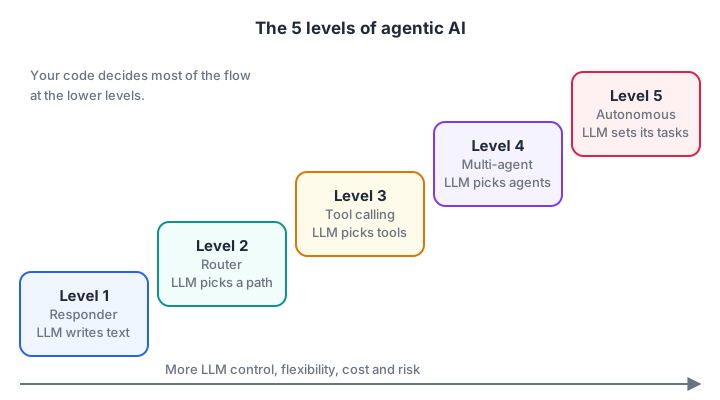
Each step up hands one more decision from your code to the model.
Levels 1 and 2: Basic responder and router
Level 1: Basic responder
The LLM receives an input and returns text. Your code decides everything else: when to call the model, what to do with the reply and what happens next. Summarising a document, drafting an email or classifying a review are level 1 tasks.
This is the safest and cheapest level, and it is where most useful LLM features still live. If your feature is "turn this into that", you probably need nothing more.
Level 2: Router
Here, the LLM picks which of several predefined paths to take. A support bot might classify a message as an order query, a complaint or a general question, and your code then runs the matching handler.
The model chooses the branch, but humans wrote every branch. That keeps behaviour predictable, since the worst a bad decision can do is send a message down the wrong, but still safe, path.
def fake_llm_classify(message):
    text = message.lower()                    # stand-in for an LLM classification call
    if "order" in text or "deliver" in text: return "order"
    if "broken" in text or "refund" in text: return "complaint"
    return "general"

ROUTES = {
    "order":     lambda m: "Order desk: checking your delivery status.",
    "complaint": lambda m: "Complaints desk: a manager will call you within 24 hours.",
    "general":   lambda m: "General: we are open 9 am to 8 pm, Monday to Saturday.",
}

def level1(message):
    return "Level 1: Thank you for your message. Our team will get back to you."

def level2(message):
    route = fake_llm_classify(message)        # the model picks the path
    return f"Level 2 [{route}]: " + ROUTES[route](message)   # humans wrote every path

for msg in ["Where is my order of 10 kg sugar?", "The rice bag arrived broken",
            "What time do you open?"]:
    print(level1(msg))
    print(level2(msg), "\n")
Level 3: Tool calling
At level 3 the model decides which tools to call, with what arguments and in what order, inside a loop. Your code still defines the available tools and runs them, but the sequence of steps is no longer fixed in advance.
This is where systems start to deserve the name "agent". The same request can take two steps one day and five the next, depending on what the tools return. The mechanics of this loop are explained in the overview of AI agents, and the schema side is covered in tools and function calling.
Below, the decision function stands in for the LLM. Notice that the path changes when stock is short.
STOCK = {"basmati rice": 12, "toor dal": 40}
PRICE = {"basmati rice": 95, "toor dal": 130, "sona masoori rice": 60}
ALTERNATIVE = {"basmati rice": "sona masoori rice"}

def decide(goal, seen):                        # stand-in for the LLM's next-step choice
    item, qty = goal
    if "stock" not in seen: return ("check_stock", item)
    if seen["stock"] < qty and "alt" not in seen: return ("suggest_alternative", item)
    if "quote" not in seen:
        return ("price_quote", seen.get("alt", item), qty)
    return ("final", seen["quote"])

TOOLS = {"check_stock": lambda i: ("stock", STOCK.get(i, 0)),
         "suggest_alternative": lambda i: ("alt", ALTERNATIVE[i]),
         "price_quote": lambda i, q: ("quote", f"{q} kg {i} = Rs {q * PRICE[i]}")}

for goal in [("toor dal", 20), ("basmati rice", 20)]:
    seen, steps = {}, []
    while True:
        action = decide(goal, seen)
        if action[0] == "final": break
        key, value = TOOLS[action[0]](*action[1:])
        seen[key] = value; steps.append(action[0])
    print(goal, "->", steps, "->", seen["quote"])
Toor dal takes two tool calls; basmati takes three, because the agent noticed the shortage and found a substitute. Nobody wrote that branch as a fixed path.
Quick check
At which level does the LLM first choose which tools to call and in what order?
Routers choose between fixed paths; at level 3 the model decides the sequence of tool calls itself.
Levels 4 and 5: Multi-agent and autonomous
Level 4: Multi-agent
Several agents, each with its own role and tools, work together. A coordinator agent might decide which specialist handles the next step, or agents pass work along a chain. The LLM now controls not just which tool runs, but which agent runs.
This helps with large tasks that mix skills, but every handoff costs extra calls and can lose context. Structures such as sequential, router and hierarchical teams are compared in multi-agent system patterns.
Level 5: Autonomous
At the top level, the system is given a goal rather than a task. It creates its own to-do list, decides when to act, and may run for hours or days with little human input. Some systems can even write new code to act as tools.
Autonomy is real but fragile. Small errors compound over long runs, and cost is hard to predict. Practical autonomous agents work inside hard limits: a spending budget, a list of allowed actions and human approval above a threshold. The simulation below shows that structure.
stock = {"sugar": 8, "atta": 55, "oil": 3, "ghee": 2}
minimum, unit_cost = 20, {"sugar": 42, "atta": 30, "oil": 80, "ghee": 300}
budget, approval_limit = 5000, 2000

tasks = [f"reorder {i}" for i, q in stock.items() if q < minimum]   # agent writes its own tasks
print("Self-generated tasks:", tasks)

for task in tasks:
    item = task.split()[1]
    qty = minimum * 2 - stock[item]
    cost = qty * unit_cost[item]
    if cost > budget:
        print(f"{task}: Rs {cost} exceeds remaining budget Rs {budget}, skipped")
    elif cost > approval_limit:
        print(f"{task}: Rs {cost} needs owner approval, queued")
    else:
        budget -= cost
        print(f"{task}: ordered {qty} units for Rs {cost}, budget left Rs {budget}")
The agent decided what to do. The budget and approval limit, written by a human, decided how far it could go.
Quick check
What should always accompany a level 5 autonomous agent?
Autonomy multiplies small errors over long runs, so human-set limits are essential.
Who controls what at each level of agentic AI
The clearest way to compare levels is to ask who makes each kind of decision.
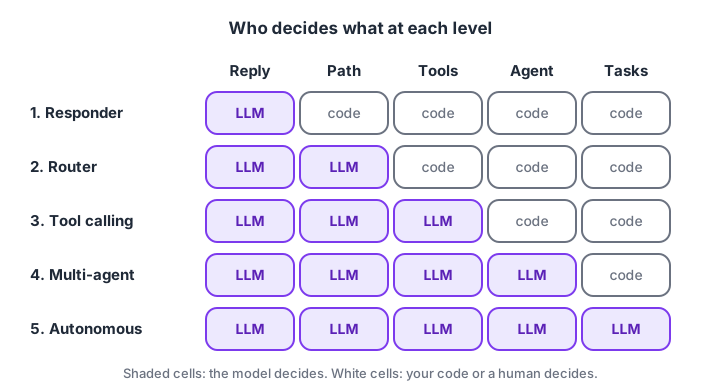
Each row adds one more kind of decision to the model's control. Everything not shaded is still decided by your code.
| Level | LLM decides | Humans or code decide | Typical example | Main risk |
|---|---|---|---|---|
| 1. Basic responder | The words of the reply | Every step of the flow | Summarise a report | Wrong or invented content |
| 2. Router | Which predefined path | All the paths themselves | Route support tickets | Misrouting |
| 3. Tool calling | Which tools, arguments and order | Which tools exist | Stock and price assistant | Wrong tool use, loops |
| 4. Multi-agent | Which agent acts next | Roles and handoff rules | Research and writing team | Lost context, cost growth |
| 5. Autonomous | Which tasks to create and when | Goal, budget and hard limits | Self-managing reorder bot | Compounding errors, runaway cost |
How to choose the right level
Work through these steps for any new feature.
- Write down the decisions the system must make. Does it only need to produce text, choose a category, choose tools or plan its own work?
- Start one level below what feels necessary. Many "agent" ideas work at level 2 with a good classifier and a few handlers.
- Move up only after a measured failure. If testing shows the router cannot handle real requests, step up to tool calling.
- Add guardrails with every level. Level 3 needs step limits and argument checks. Level 5 needs budgets, allowlists and approvals, as covered in guardrails for AI agents.
Common mistakes with agentic AI levels
- Treating higher as better. A level 5 system doing a level 2 job is slower, costlier and less predictable.
- Skipping the router. Many teams jump from a single prompt to full tool calling when a classifier and three handlers would do.
- Autonomy without budgets. Any system that creates its own tasks needs a hard cap on spend and steps.
- Mixing levels without noticing. One product can contain levels 1, 2 and 3 in different features. Label each, so its risk is reviewed correctly.
Key takeaways
- The five levels are responder, router, tool calling, multi-agent and autonomous.
- The difference is how much of the control flow the LLM decides.
- Higher levels add flexibility but also cost, variance and risk.
- Choose the lowest level that works, and move up only after measuring a failure.
- Learn the vocabulary across all levels in the agentic AI glossary.
FAQ
What are the 5 levels of agentic AI?
They are basic responder, router, tool calling, multi-agent and autonomous. At level 1 the LLM only writes text inside a fixed flow, and at each level after that it takes over more decisions, ending with level 5, where it creates and schedules its own tasks within limits set by humans.
Is a chatbot an agentic AI system?
A simple chatbot that only replies is level 1. If it routes messages to different handlers it is level 2, and once it chooses and calls tools in a loop it is level 3, a genuine agent. The label depends on what the system is allowed to decide, not on its interface.
Are fully autonomous AI agents used in real businesses?
As of November 2026, mostly in narrow, well-bounded jobs with strict budgets, allowlists and human approval for important actions. Open-ended autonomy over long periods remains unreliable, because small mistakes compound. Most production systems that work well sit at levels 2 to 4.
What level of agentic AI should beginners build first?
Build a level 2 router, then a level 3 tool-calling agent. Together they teach classification, tool schemas, loops and stopping rules, which every higher level depends on. Multi-agent and autonomous systems are much easier to debug once those basics are solid.
Can I learn to build agentic AI systems in Indore?
Yes. Debugshala covers routers, tool-calling agents and multi-agent systems in its Indore Generative AI course for freshers and career switchers, taught at Old Palasia in English and Hindi. A free demo class is available before you enrol, and aptitude and coding quizzes on Debugshala Test help you prepare.
From the team behind this site
Go further with the Generative AI Course at Debugshala
These tutorials are written by Debugshala, a training and placement institute at Old Palasia, Indore. The classroom course adds live mentoring, real projects and interview preparation.
- Offline classes at Old Palasia, Indore
- Free demo class before you pay
- Non-IT, fresher and year-gap friendly
- Placement assistance
700+ students placed · 200+ hiring partners · 4.9★ Google rating
